

Become a Forex trader expert by following through with our education package. We are available 24/7 to assist you at every step of the way.
Because you are always comparing one currency to another, forex is quoted in pairs. This may seem confusing at first, but it is actually pretty straightforward. To the right is an example of a EUR/USD quote. It shows you how much one euro (EUR) is worth in US dollars (USD).
If you, instead, wanted to look at the euro in terms of the Japanese yen (JPY), you would look at the EUR/JPY rate. If you wanted to see the value of a US dollar in Canadian dollars (CAD), you would look at the USD/CAD.
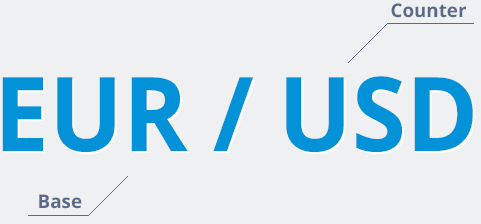
The first currency in a currency pair is the "base currency"; the second currency is the "counter currency". When you buy or sell a currency pair, you are performing that action on the base currency. So, if you are bearish of euros, you could sell EUR/USD. Now, when selling EUR/USD, you are not only selling euros, but are buying US dollars. If you are more bullish on the Japanese yen than you are on the US dollar, you could sell the EUR/JPY instead. It's all up to you.
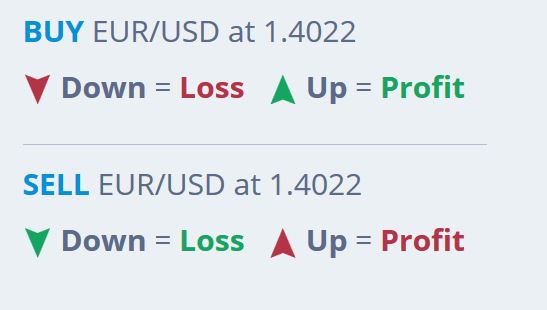
Let's say that you sell EUR/USD at 1.4022. If the EUR/USD falls, that means the euro is getting weaker and the US dollar is getting stronger. Say the EUR/USD falls to 1.3522. In that case, you would have a profit. If it rose to 1.4522, you would have a loss. So just remember: if you sell a pair, down is good; if you buy the pair, up is good.
You can buy or sell anything you see active on your trading station, even if you don’t have any of that currency. When trading forex, you are speculating on the change in rates. You do this by borrowing the euros. This is standard for most forex traders. This also allows you access to leverage, which can increase your profits and your losses.
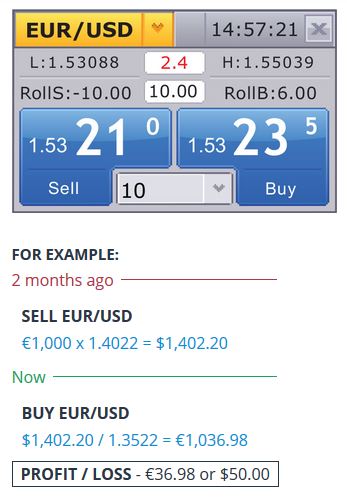
So, let’s look at the example again. When you sell EUR/USD, you borrow 1,000 euros and sell them to someone else in the market, earning the equivalent in US dollars. Say you did this while the EUR/USD is at 1.4022. In that case, you borrowed 1,000 euros, sold them for $1,402.20, and held on to those US dollars.
Two weeks later, you sold those US dollars when the rate was 1.3522. Since the EUR/USD price has fallen, you get more euros back at the end than you borrowed. So, you return the 1,000 euros you borrowed, and the remaining €36.98 is your profit to keep. If the price had risen to 1.4522 instead, that €36.98 would instead be a loss. Your trading station will do the math for you and apply the profit or loss directly to your account.
Buy currencies that are going up. Sell currencies that are going down.
Find the best pair to do that with.