

Become a Forex trader expert by following through with our education package. We are available 24/7 to assist you at every step of the way.
Many traders come to the forex market for the wide availability of leverage — the ability to control a trading position larger than your available capital. However, while using high leverage has the potential to increase your gains, it can just as quickly, and perhaps more importantly, magnify your losses.
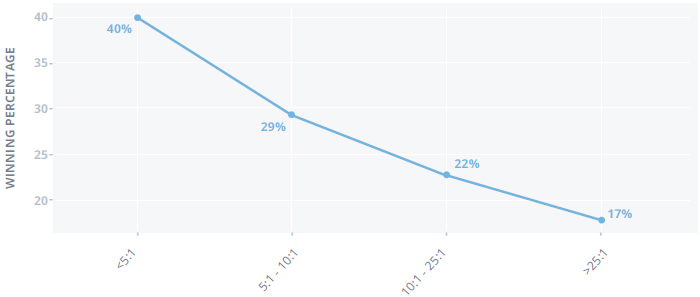
Chart 4: Percentage of Profitable Traders by Average Effective Leverage.
Data source: FXCM accounts excluding Eligible Contract Participants, Clearing Accounts, Money Managers, and Hong Kong and Japan subsidiaries from 3/1/2014 to 3/31/2015.
Profitability declines substantially as effective leverage increases: 40% of traders using an average effective leverage of 5:1 or lower turned a profit while only 17% using 25 :1 or higher closed at a profit.
Excessive leverage makes profitability significantly less likely.
Tom and Jerry each open a 10K account and look to trade EUR/USD (MMR $26 per 1K). Both use a 1:2 risk-reward ratio with a stop at 100 and a limit at 200. However, they use two different leverage ratios.
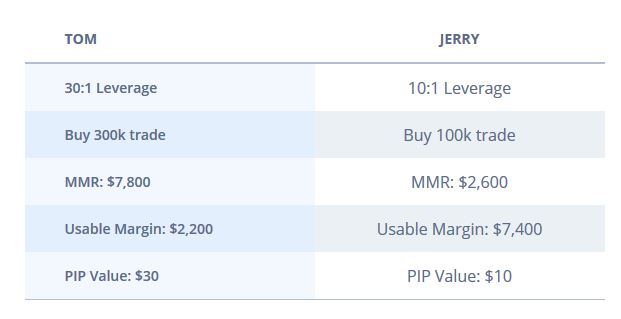
But EUR/USD trades down, falling 60 pips. At the end of the trading day:
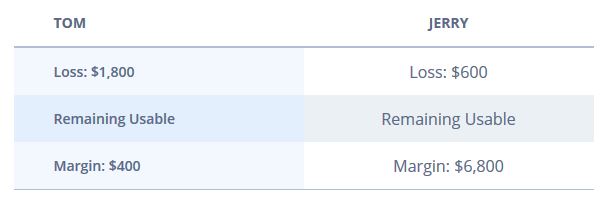
When the trade went against Tom, the trade didn't have room to draw down, and the usable margin quickly evaporated, pushing him close to a margin call. Jerry has appropriate leverage (and stops and limits) to allow the trade space to move back into favor.
Ultimately, the same move in the market cost Tom three times what it cost Jerry. The higher your leverage, the greater your risk on each trade, likely amplifying irrational decision-making.
Finding Effective Leverage
To calculate leverage, divide your trade size by your account equity.
Knowing the link between leverage and equity is important. Now, you have to decide how much you are willing to risk and set your trading capital accordingly. To find effective leverage, consider two inputs: trade size and equity.
Say you open an account with $10,000 in equity. A 10:1 leverage would mean opening positions no larger than $100,000 at a time.
Chart 5: Percentage of Profitable Traders by Average Trading Equity
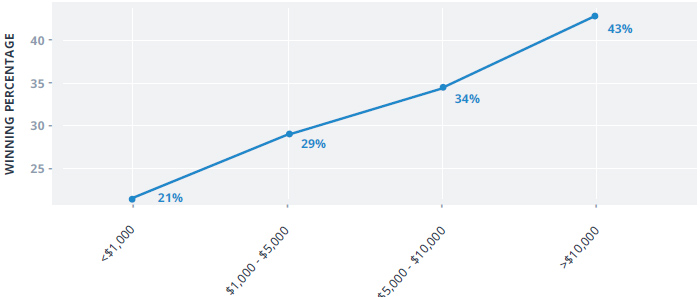
Data source: FXCM accounts excluding Eligible Contract Participants, Clearing Accounts, Money Managers, and Hong Kong and Japan subsidiaries from 3/1/2014 to 3/31/2015.
Given the relationship between profitability and leverage, you can see a clear link between average equity used and trader performance. At the low end, a mere 21% of traders with $1,000 equity turned a profit.
Those with more than $10,000 in equity were more than twice as likely to see profits. Those with under $1,000 in equity used an average of 28:1 leverage, while traders with more than $10,000 used an average of 5:1.
Chart 6: Average Effective Leverage Used by Average Trading Equity
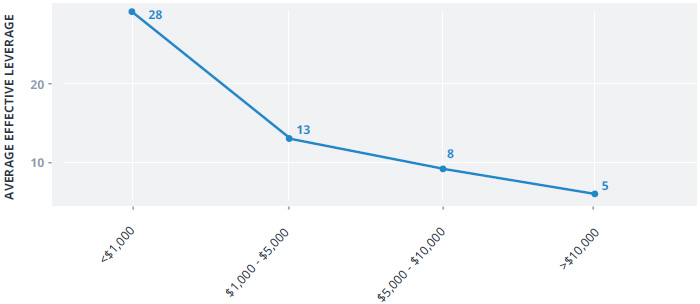
Data source: FXCM accounts excluding Eligible Contract Participants, Clearing Accounts, Money Managers, and Hong Kong and Japan subsidiaries from 3/1/2014 to 3/31/2015.
Only risk 10% or less of your account balance at any given time. Add the cash value of your entire exposure to the market (all your trades), and never let that amount exceed 10 times your equity.
To calculate leverage of a single trade, divide your trade size by your account equity.