

Become a Forex trader expert by following through with our education package. We are available 24/7 to assist you at every step of the way.
Historically, this simple adage has been difficult to adhere to. Take the EUR/USD. Our data shows EUR/USD trades closed out at a profit 61% of the time. But the average losing trade was worth 83 pips while the average winner was only 48 pips. Traders lost 70% more on their losing trades than they won on winning trades. Remember that past performance is no indication of future results. Why the imbalance? Human behavior toward winning and losing can explain.
Chart 1: Percent of Winning/Losing Trades By Currency Pair
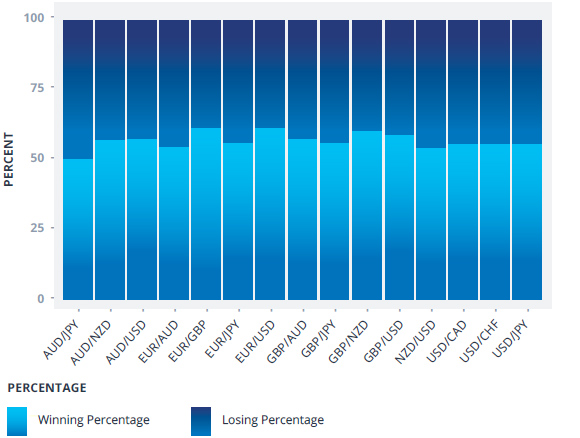
Data source: FXCM accounts excluding Eligible Contract Participants, Clearing Accounts, Money Managers, and Hong Kong and Japan subsidiaries from 3/1/2014 to 3/31/2015.
Chart 2: Average Profit/Loss per Winning and Losing Trades per Currency Pair
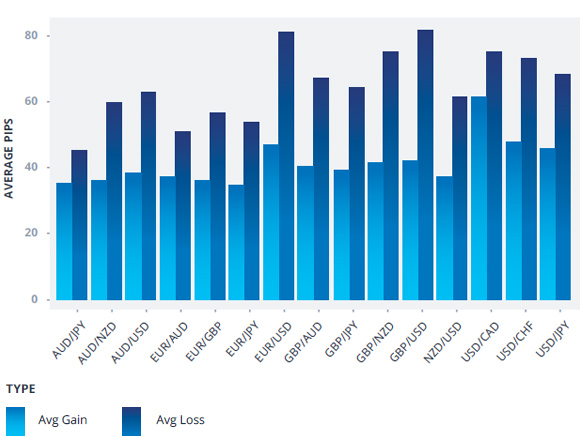
Data source: FXCM accounts excluding Eligible Contract Participants, Clearing Accounts, Money Managers, and Hong Kong and Japan subsidiaries from 3/1/2014 to 3/31/2015.
Imagine a wager. You have two choices. Choice A, we flip a coin. Heads, you win $1,000, and tails, you win nothing. Choice B, we flip a coin, but heads or tails, you win $450. Which would you choose? Over many flips, say 100, choice A makes sense. If you get heads half the time, you'd make $50,000. The more heads you get, the more you make. With B, the most you can make is $45,000. Human psychology suggests most people choose B, because the guarantee is perfectly acceptable. Let's flip the wager and run it as a loss. Choice A, heads you owe $1,000, and tails, you owe $0. Choice B, you owe $450 regardless of heads or tails. Again, psychology suggests the majority of people pick A every time. People avoid risk when it comes to a potential profit but accept risk to avoid a guaranteed loss. We take more pain from loss than pleasure from gain.
When trading, follow a simple rule: Seek a bigger reward than the loss you risk.
This is called a risk-reward ratio. If you risk losing the same number of pips you hope to gain, then you risk-reward ratio is 1:1, meaning you set your stop and limit equidistant from your buy or sell price. If you take a 40-pip risk (stop) and target an 80-pip profit (limit), you have a 1:2 risk-reward ratio.
The higher the risk-reward ratio you choose, the less often you need to predict market direction correctly to make money. You should, however, use at least a 1:1 risk-reward ratio: If you are right only half the time, you break even.
Once you have a trading plan that uses a proper risk-reward ratio, the next challenge is to stick to the plan. Consider the coin flip wager. The tendency is to hold onto losses and take profits early. This is not the best strategy for proper risk management.
Instead traders should remove emotions from trading. A good way to do this is to set up your trade with stop and limit orders from the beginning. This allows you to use the proper risk-reward ratio (1:1 or higher) from the outset, and to stick to it.
Once you set stops and limits, don't touch them!
question_answer Does 1:1 or higher really work? Our data certainly suggest it does.
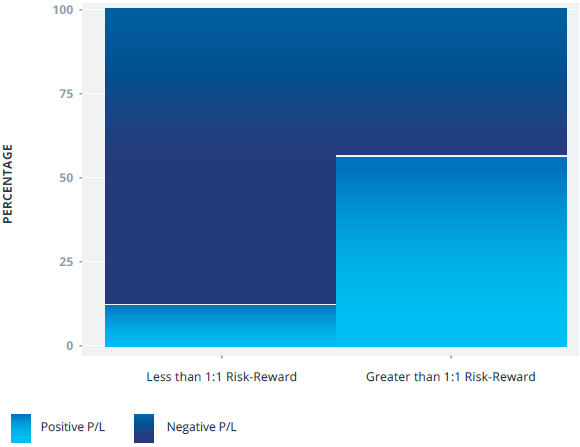
Chart 3: Profit and Loss by Risk-Reward
Of the traders who traded 1:1 or higher risk-reward, 53% turned a profit; of those who didn't, 17% turned a profit. Traders who adhered to this rule were three times more likely to turn a profit—a substantial difference.
Open nearly any book on trading and the advice is the same: Cut your losses early and let your profit run. When your trade goes against you, close it out—better to take a small loss early than a big loss later.
Data source: FXCM accounts excluding Eligible Contract Participants, Clearing Accounts, Money Managers, and Hong Kong and Japan subsidiaries from 3/1/2014 to 3/31/2015.
Game Plan: USE STOPS AND LIMITS SET TO A RISK-REWARD RATIO OF 1:1 OR HIGHER.
When you place a trade, use a stop-loss order. Aim for at least 1:1 regardless of strategy. The actual distance you place your stops and limits depends on market conditions, such as volatility, currency pair and where you see support and resistance.
Easily calculate your trade size with stops and limits using the Risk Management Indicator.